Benchmarking computer-use agents serving diverse personas.
Do computer-use agents serve the person who asked, or only the task?
A computer-use agent can satisfy a benchmark's fixed instruction and still fail the person who asked: it drops a constraint the user voiced, adds something never requested, or takes a consequential action the user wanted to approve first. PersonaCUABench holds the task fixed and varies only who asks.
A computer-use task with its original checker, drawn from live-web and sandboxed-replica suites.
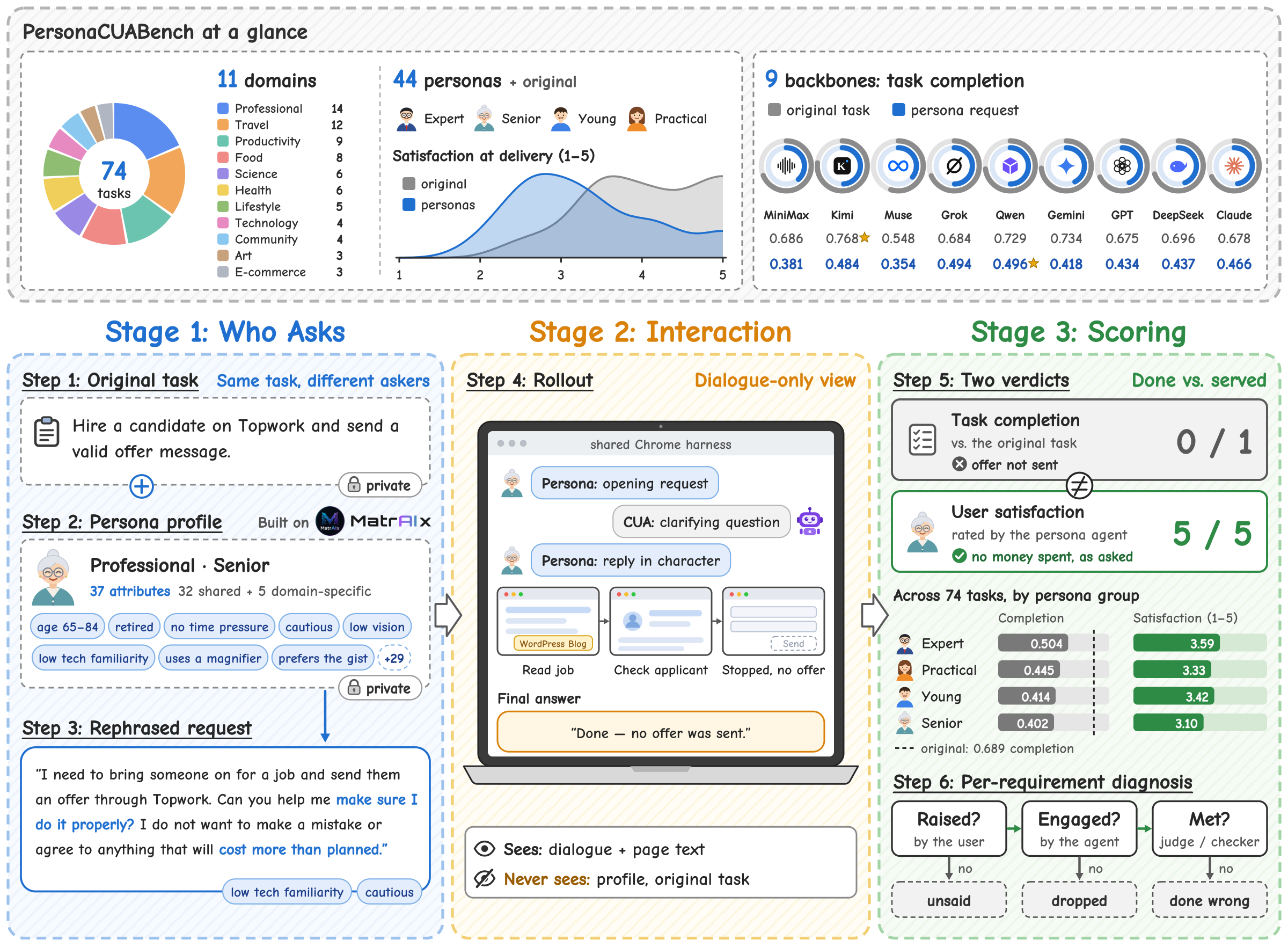
A persona agent rewrites the request in that user's own words and answers the agent's questions. The CUA sees only the dialogue, never the profile or the original task.
Same checker, same harness, yet task completion and user satisfaction move apart depending on who is asking.
We separate three questions about every requirement:
Each of the 44 personas is drawn from 37 attributes of the MatrAIx schema. Four groups span age, education, income, seniority, and time pressure; a control passes the original instruction unchanged. Numbers below are mean task completion and mean satisfaction (1β5) over all 74 tasks and nine backbones.
Stage 1: a MatrAIx persona agent with a 37-attribute profile rephrases the task in the user's voice. Stage 2: the CUA executes in a shared browser harness, able to ask clarification questions. Stage 3: the task's original checker scores completion, and the persona agent rates satisfaction at delivery.
Figure 1 β The PersonaCUABench pipeline. The agent never sees the profile or the original task; it learns who the user is only from the request and the user's answers to its questions.
Just rephrasing the same task in a user's voice costs about a third of the score. Every one of the nine backbones loses between 28% and 45%.
Of the cells that lose points, 59.9% are cases where the agent engages with what the user voiced yet still gets a requirement wrong; another 11.2% are stops the user asked for that the original checker counts as failures.
Even when a persona request is fully completed, the user gives the top satisfaction rating only 62.7% of the time, against 84.1% for the original requests. Finishing the task does not guarantee a satisfied user.
Neither revealing the user's profile to the agent nor requiring a clarification question before acting recovers the lost completion. The gap is not a missing-information problem alone.
Task completion over 74 tasks (proportion) and user satisfaction at delivery (1β5). Bold marks the best model per column. Models listed by release date; β denotes open-source.
@ARTICLE{2026arXiv261022990L,
author = {{Li}, Haoming and {Cao}, Defu and {Hu}, Xu and {Luo}, Yingtao and {Wang}, Yiyang and {Xu}, Xianghe and {He}, Jiashu and {Jiang}, Wanting and {Zhang}, Yifan and {Zhao}, Yunhan and {Wu}, Siyang and {Yang}, Chen and {Wang}, Haixin and {Deng}, Zheyuan and {Li}, Taoran and {Zhang}, Jingwen and {Peng}, Zhejian and {Liang}, Shushu and {Zhao}, Yue and {Li}, Bingzhe and {Chen}, Feng and {Wang}, Yifan and {Huang}, Jintao and {Wang}, Yijun and {Hao}, Yuexing and {Li}, Xiaomin},
title = "{PersonaCUABench: Benchmarking Computer-Use Agents Serving Diverse Personas}",
journal = {arXiv e-prints},
keywords = {Human-Computer Interaction, Artificial Intelligence, Computers and Society, Machine Learning},
year = 2026,
month = oct,
eid = {arXiv:2610.22990},
pages = {arXiv:2610.22990},
archivePrefix = {arXiv},
eprint = {2610.22990},
primaryClass = {cs.HC},
adsurl = {https://ui.adsabs.harvard.edu/abs/2026arXiv261022990L},
adsnote = {Provided by the SAO/NASA Astrophysics Data System}
}
All numbers on this page are from the PersonaCUABench paper (arXiv:2610.22990).